.png)
Adding Links to Your Site
You can link body text, headings, buttons, images, and gallery images to pages on your site, external pages, files, email addresses, and phone numbers in the Site Editor. Links help visitors move through your site and reach resources outside it. Choosing where a link opens lets you control how visitors experience navigation.
Please Note: This article is about links inside page content (the body of your site). It does not cover links in the top Navigation Menu (in the site header). For header or menu links, see Adding a Link to the Navigation Menu.
Table of Contents
Linking Elements in Site Editor
You can add a link from the element toolbar or from the Link tab, depending on the element type. These steps apply to Text, Heading, Button, Image, and Gallery elements.
- Click the element to open its toolbar or highlight the text you want to link.
- Click the Link button in the toolbar.
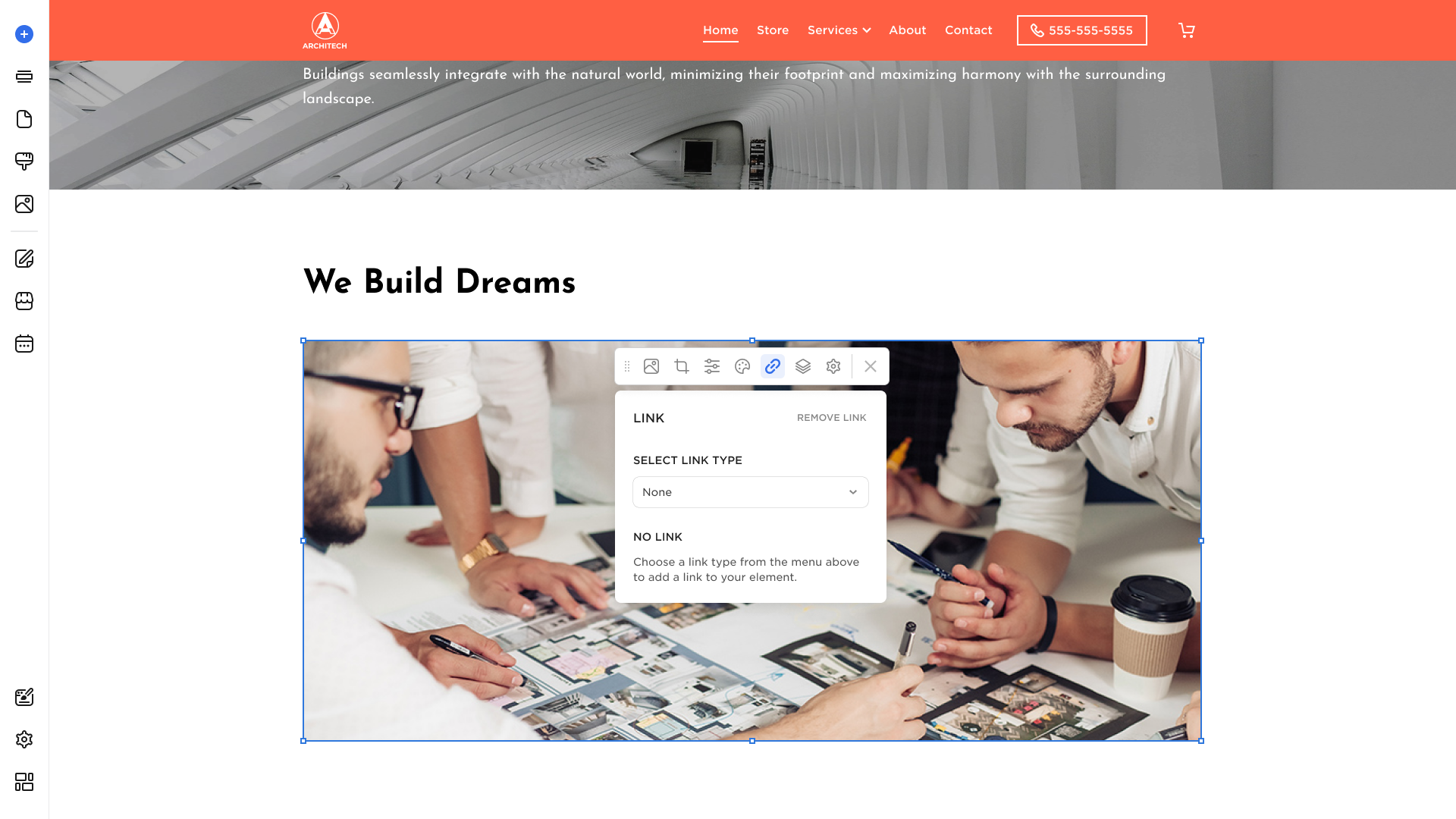
- Configure the link using the options described in the sections below.
Link Types
Select the link type from the drop-down menu:
- None. No link is applied to the element. Use this to remove an existing link.
- Page. Link to another page on your website. Choose the page from the list that appears.
- Anchor. Link to a specific section on a page. Choose the page and the anchor (section) on that page.
- URL. Link to an external website address (for example,
https://example.com). - File. Link to a downloadable file.
Supported File Types:
- Images: jpg, jpe, jpeg, png, gif, bmp, svg, tiff, max 15 MB.
- Documents: css, html, htm, xml, doc, docx, pdf, otf, rtf, xls, eps, zip, gzip, csv, ppt, pptx, odt, ods, odp, odf, odc, xlsx, txt, js, sketch, ai, psd, psb, cdr, cad, max, obj, rar, 7z, tar, tar.gz, bz2, stl, fbx, vrml, .odt, .odp, .ods, .odg, .odf, .sxw, .sxi, .sxc, .sxd, .stw, .dwg, .dwt, .dxf, .dwf, .dst, max 25 MB.
File Storage: Uploaded files are stored in your project's specific folder. Access them in the My Documents tab of the Upload dialog:

- Email Address. Link that opens an email to a specified address (for example,
contact@example.com).
When a visitor clicks the linked element (text, heading, button, or image) on your live site, a new empty message opens with the mailto address field prefilled with the email address you specified. The email client installed on the visitor's computer (such as Outlook) will be used. If the visitor has no email client installed, the browser will try to open a web-based email service configured in the browser settings.
- Phone Number. Link that initiates a call to a specified number.
Adding an External URL to Website Body
To link an element to an external website URL:
- Click the element you want to link, or highlight the text inside a Text or Heading element.
- Click the Link button in the toolbar above the element.
- Select URL from the link type drop-down.
- Enter the full external URL in the field (for example,
https://www.example.com). - Turn on the toggle to open the link in a new tab.
- Click Update Website (or Publish Website if this is your first publish) so the link appears on your live site.
Tip: Use a complete URL that includes https:// so the link works reliably for all visitors.
Please Note: For images, the On Click Enlarge functionality is unavailable if the image is linked to a page, anchor, URL, file, email address, or phone number.
Removing a Link
To remove a link from an element in the page body:
- Click the element and open the link settings.
- Select None from the link type drop-down.
- Click Update Website if your site is already published so visitors see the change.
The element will no longer be linked.