.png)
Text & Heading
Headings are essential tools for structuring your content. By establishing a visual hierarchy, you can emphasize key points and improve readability. A well-structured hierarchy helps you achieve your website's goals: raising awareness, educating your audience, or driving conversions.
The site's content is built on the principle of a hierarchy of elements - from largest to smallest. It consists of:
- Header 1: The largest and most prominent heading for main titles and important announcements.
- Header 2: A significant heading used to introduce major sections or topics.
- Header 3: A sub-heading used to further organize major sections into more specific topics.
- Header 4: A standard heading used to divide content into smaller sections.
- Header 5: A smaller heading used to introduce subsections or subtopics.
- Header 6: The smallest heading used to label specific points or lists.

Please refer to the Improving SEO in Site Editor article to learn about the best practices on how to use Headings for SEO & Accessibility.
Table of Contents
- Adding Text or Heading to Your Website
- Option 1
- Option 2
- Moving and Resizing Text or Heading
- Customizing Text or Heading
- Editing Heading
- Editing Text
- Deleting Text or Heading
- More Menu
- Common Questions
Adding Text or Heading to Your Website
Option 1
- In the Site Editor, open the page where you want to add the text or heading.
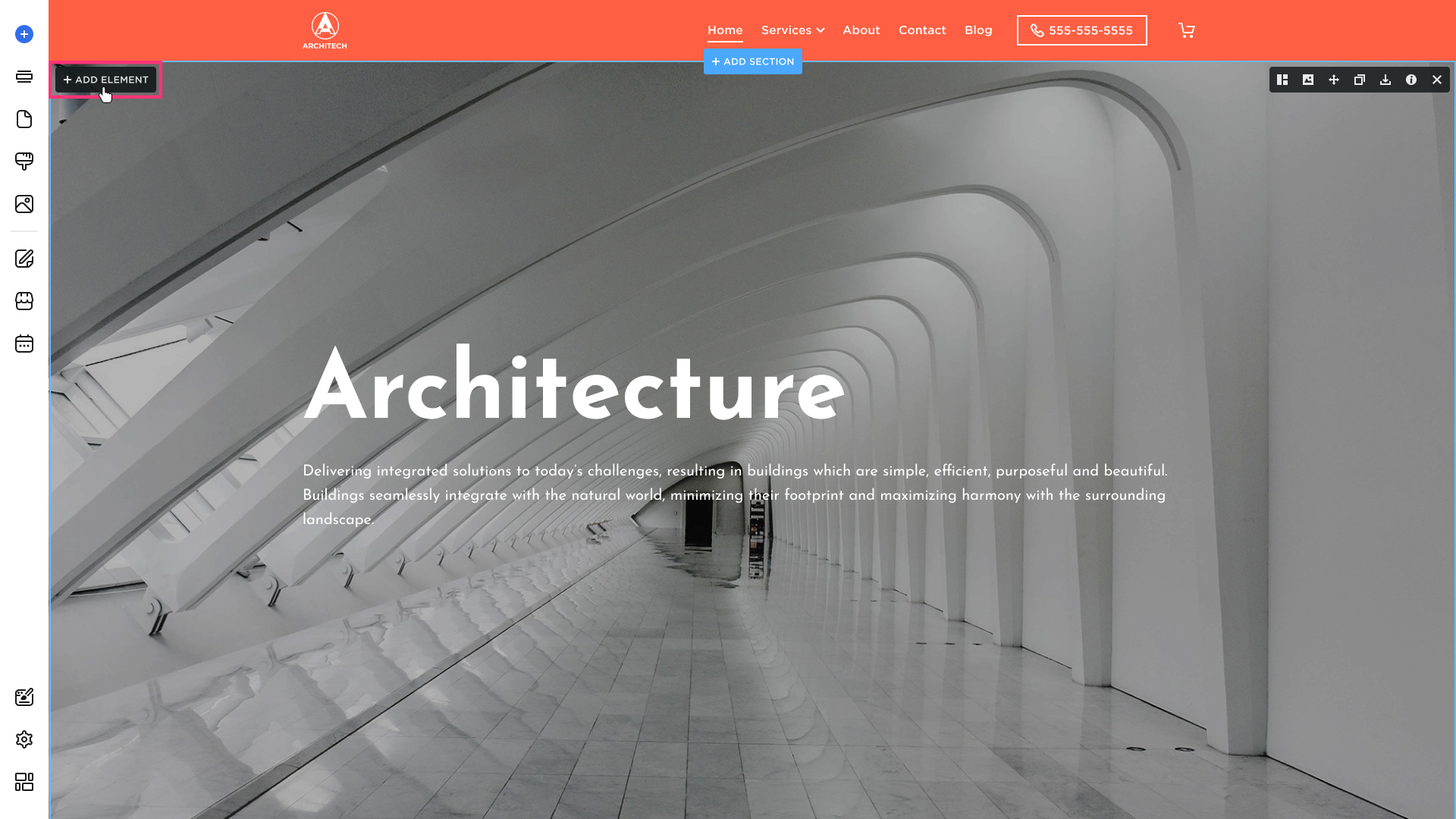
- Hover over the desired section and click Add Element in the upper-left corner of that section:
- In the Add an Element panel on the left, select Text or Heading in the Design section:
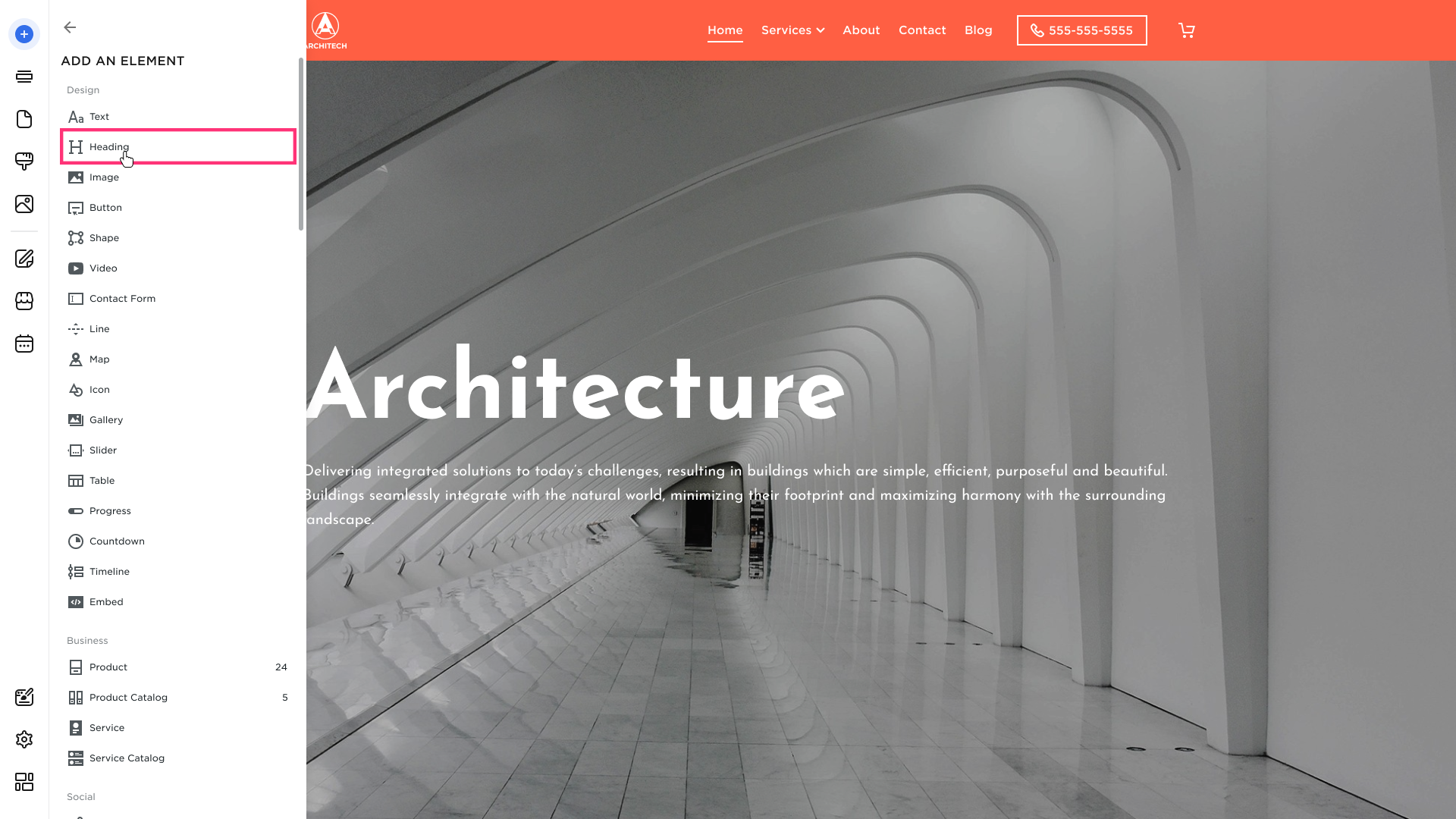
- After you choose the element from the list, drag it to the desired section and drop using the grid.
Option 2
- In the Site Editor left sidebar, click the Build (+) button at the top.
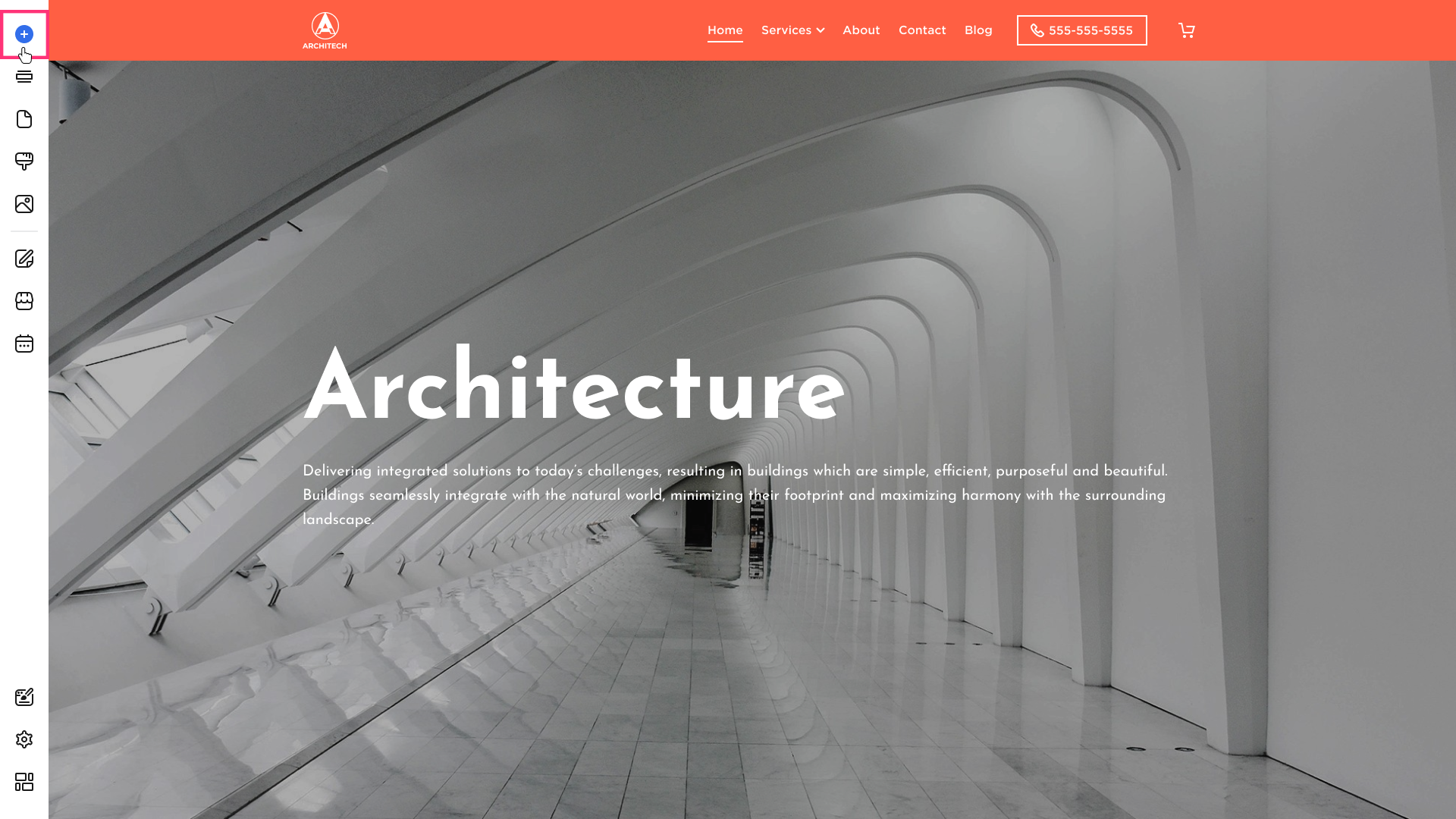
- In the Add an Element panel on the left, select Text or Heading in the Design section:
- After you choose the element from the list, drag it to the desired section and drop it using the grid.
Moving and Resizing Text or Heading
Please refer to the Elements Management (Drag and Drop Grid) article to learn more about moving and duplicating elements.
Customizing Text or Heading
Click a Text or Heading element on the page. An editing menu will appear directly above the selected element. Use it to edit, duplicate, layer, or delete the element:

Editing Heading
Click Heading element to show the toolbar or highlight the text you want to change:
- AI Writer. Click the AI Writer button and enter the Post Topic to generate new text and click Write My Idea.
- Color. Select the text color and its opacity by clicking the Square icon.
- Font. Select font, style, and format.
- Heading. Choose the heading variation: Header 1, 2, 3, 4, 5, or 6.
- Bold. Make the selected text bold by clicking the button.
- Italic. Make the selected text italic by clicking the button.
- Underline. Make the selected text underlined by clicking the button.
- Strikethrough. Make the selected text strikethrough by clicking the button.
- Alignment. Align the text element to the left, right, or center.
- Link. Add a link to a page (and select a page), anchor (page and section), URL, file, email address, or phone number. You can also turn on the toggle to open a link in the new tab.
- Align vertically. Align the text element to the top, center, or bottom.
- Remove formatting. Click the button to clear the format of the selected text.

Editing Text
Click a Text element to show the toolbar or highlight the text you want to change:
- AI Writer. Click the AI Writer button and enter the Post Topic to generate a new text and click Write My Idea.
- Color. Select the text color and its opacity by clicking the Square icon.
- Font. Select font, style, and format.
- Bold. Make the selected text bold by clicking the button.
- Italic. Make the selected text italic by clicking the button.
- Underline. Make the selected text underlined by clicking the button.
- Strikethrough. Make the selected text strikethrough by clicking the button.
- Alignment. Align the text element to the left, right, or center.
- List. Select the bullet style, bullet color, and the offset size.
- Link. Add a link to a page (and select a page), anchor (page and section), URL, file, email address, or phone number. You can also turn on the toggle to open a link in the new tab.
- Align vertically. Align the text element to the top, center, or bottom.
- Remove formatting. Click the button to clear the format of the selected text.
Tip: You can set the Font Theme settings to customize the font styles to match your preferences. These font settings are global and apply to all website pages. Please refer to the Theme: Fonts article to learn more.

Tip: Use the Spell Checking functionality in your browser to spot spelling and grammar mistakes. You can identify misspelled words and grammatical errors while editing text elements by enabling a spell-checker extension in Firefox or Chrome. Alternatively, you can spell-check your text in an editing program before adding it to your site.
Deleting Text or Heading
- Click the Text or Heading element on the page.
- Click the Remove button [Bin] in the toolbar:

- The element will be removed immediately.
More Menu
- Click the More icon (⋮) in the editing menu to access the available options:

- Cut. Click Cut or Ctrl+X to cut your element.
- Copy. Click Copy or Ctrl+C to copy your element.
- Duplicate. Click Duplicate or Ctrl+D to duplicate your element. The duplicate will appear immediately.
- Delete. Click Delete to remove the element. The element will be deleted immediately.
- Move Forward. Click Move Forward or Ctrl+⇓ to move your element.
- Move Forward. Click Move Forward or Ctrl+⇑ to move your element.
Please Note: The Move Forward or Move Backward options are available only when one element is added on top of another.

- The element will be immediately removed.
Common Questions
Why can't I just click on the page and start typing?
Website Builder uses Text and Heading elements. You must add one of these elements to the page first, then click it to enter and edit content. Clicking empty page space does not create a text field.
What is the difference between Text and Heading elements?
- Text: For paragraphs and body copy. Supports bullet lists. Use for descriptions, explanations, and general content.
- Heading: For titles and section labels. Supports Header 1 through Header 6 levels for visual hierarchy. Use for page titles, section titles, and subheadings.
How do I add a bulleted list?
Use a Text element (not Heading). Click the Text element, then click the List button in the toolbar to choose bullet style, bullet color, and offset size.
Can I duplicate a text block?
Yes. Click the Text or Heading element, then either:
- Click More (⋮) in the toolbar → Duplicate (or press Ctrl+D), or
- Use Copy and paste as needed.
The duplicate appears immediately on the page.
How do I change fonts site-wide?
Font changes in the text toolbar apply to that element. For global font styles across all pages, use Font Theme settings. See Theme: Fonts.
Can I link Text or Heading to an external URL or attach a file?
Yes. You can link selected text inside a Text or Heading element to:
- An external URL (another website)
- A file uploaded to your project (for example, PDF, DOC, or image)
- A page on your site, an anchor, an email address, or a phone number.
How to add a link:
- Click the Text or Heading element and highlight the text you want to link.
- In the floating toolbar above the element, click Link (chain icon).
- Choose the link type:
- URL — enter an external web address.
- File — select or upload a file from your project (stored in My Documents in the Upload dialog).
- Page, Anchor, Email, or Phone as needed.
- Optionally turn on the toggle to open the link in a new tab.
- Publish your site to apply changes.
For full steps and supported file types, see Adding Links to Your Site.